
Manatee Science Activities for Kids: Hands-On Marine Mammal Learning
Gentle Giants, Warm Waters, and Marine Mammal Learning
I grew up in Florida, and manatees were just part of my childhood.
We lived near a canal with brackish water, a mix of salt and fresh water, and somehow it felt completely normal that manatees, sharks, alligators, and dolphins could pass through the same stretch of water. I wasn’t supposed to play in it… and I didn’t, really. But looking back, I probably sat a little too close to the edge more than once.
There was a concrete pad near the water that sat almost flush with the surface. If you sat on it, you were just slightly above the waterline. Sometimes, several manatees would drift right beneath you. It felt unreal, these huge shadows moving under the surface.
When I think of manatees, I don’t just think of a marine mammal. I think of being a kid, sitting still, and watching something enormous and gentle glide by. So, they’ve always felt special to me.
Years later, when my own kids started getting curious about my “home state,” manatees were one of the first animals we talked about. They aren’t flashy. They don’t leap like dolphins or hunt like sharks, but they are fascinating in their own way. I mean… sailors once mistook them for mermaids!
Once you start learning about how they live, how they float, how they stay warm (or don’t), and how much they eat… you realize they’re far more interesting than their slow pace suggests.
Manatee Day (March 30th) is a great excuse to learn about them, but truly, they fit beautifully into any study of marine biology, habitats, mammals, or conservation.
You don’t need an ocean nearby (or crazy brackish water)… just a few simple ways to make their world visible.
🌊 What Makes Manatees So Fascinating?
Manatees are often called “sea cows,” and while that sounds funny, it’s actually accurate in some ways.
They are:
- Large herbivores
- Slow-moving
- Social but quiet
However, they are more closely related to elephants than cows and unlike whales, they don’t migrate long distances through icy seas. Instead, when temperatures drop, they gather in warm-water springs or areas where power plants release warm water. If the water gets too cold, they can suffer something called cold stress, which can be deadly.
That alone opens up such good conversations with kids about habitat and adaptation.
🌊 Manatee Science Facts
- Manatees are marine mammals.
- They sleep for about 50% of the day.
- Their lungs run along their backs, helping control buoyancy.
- They eat about 10-15% of their body weight in plants every day.
- They can hold their breath for up to 20 minutes (though they usually surface every few minutes).
- They are closely related to elephants and like elephants, have great long-term memory.
🌊 Fun Facts Kids Love
- Manatees have fingernails on their flippers.
- Baby manatees are called calves.
- Manatees can weigh as much as a small car.
- They have no natural predators as adults. (Though there are rare incidents of alligator or shark attacks on calves, though so rare, it can’t be considered a natural predatory relationship)
- They move slowly, but they are surprisingly strong.
⭐ Hands-On Manatee Science Activities
Each of these connects directly to something that makes manatees unique — buoyancy, temperature sensitivity, and herbivore digestion.
1. How Do Manatees Float? (Lung & Buoyancy Investigation)
One of the coolest things about manatees is how they control their position in the water. They don’t rely on blubber to float (or stay warm). Instead, their lungs run along their backs and help them rise and sink gently. They can adjust how much air they hold to control buoyancy.
Here’s a simple way to explore that idea.
You’ll Need:
- Two balloons
- A large bowl or tub of water
- Tape
- A small coin or washer
What to Do:
- Blow up one balloon fully. Blow up the other halfway.
- Place both gently in water and observe.
- Which one floats higher? Which one sinks lower?
- Now tape a small coin to both balloons and place it back in the water.
- What changed?
This simple demonstration shows how air volume affects buoyancy. More air means more lift. Less air means sinking lower.
Then connect it back by asking…
If a manatee wants to float near the surface, what would it do?
If it wants to sink slightly to graze underwater plants, what would it adjust?
It’s such a simple experiment, but it makes the lung importance visual.
2. Do All Water Mammals Stay Warm the Same Way?
Whales and seals can live in icy water because they have blubber… a thick, specialized layer of fat that insulates them. Manatees don’t have true blubber like that. They have thick skin and body fat, but they are much more sensitive to cold.
This experiment helps kids feel the difference.

You’ll Need:
- Materials from my Blubber experiment
- A second tub of ice water
What to Do:
- Set up the Blubber experiment
- Set up an additional bowl or bin of ice water (big enough to submerge a hand)
- Follow the directions of my Blubber experiment with one hand and place other in just the ice water bowl
- Wait 20–30 seconds.
Which hand feels colder faster? The hand inside the “blubber” layer stays warmer longer.
Now ask…
If whales and seals can live in icy water because of blubber… what happens to a manatee when water temperatures drop? Why would manatees need warm springs or warmer coastal waters?
This turns a familiar experiment into something more meaningful, a lesson about adaptation and limits.
3. How Much Does a Manatee Eat?
Manatees are herbivores, and they eat an incredible amount of vegetation every day. An adult manatee can eat 10-15% of its body weight daily.
That’s huge and here’s how to make that visible.
You’ll Need:
- A bathroom scale (if you don’t know your child’s weight)
- A kitchen scale
- An appropriate amount of fruits and veggies that you would normally eat
What You’ll Do:
- Weigh your child (or use a known weight)
- If a child weighs 60 pounds, 10% of that is 6 pounds.
- Then have your child help you weigh the right amount of fruits and veggies to make up 10% of their weight. hold up 6 pounds of something.
Then Ask:
Could you eat that many fruits and veggies in one day? Now imagine a 1,000-pound manatee eating 100 pounds of plants in a single day.
This opens up conversations about…
- Why they move slowly
- Why they stay in vegetation-rich habitats
- How important aquatic plants are to ecosystems
It also helps kids understand scale in a way that numbers on a page never do. For fun do parent’s weight too. It will be hilarious to see 5 pounds of apples, 5 pounds of oranges, 5 pounds of potatoes, and 3 pounds of carrots for a 180 pound person. Just make sure to get ones you know you will eat!
4. Manatee Habitat Sensory Play
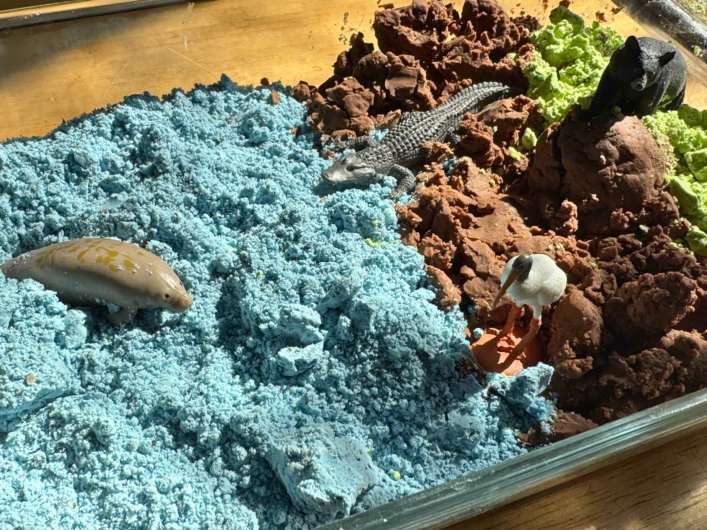
If you want something hands-on for your manatee science activities, create a water habitat. This is a great excuse to make water and mud dough, or you can use real water and sand.
Above, we created a sensory play area. It includes a 9×13 dish, some of the sensory dough (see below), and a pack of toys that depict the animals of the Everglades.
Set out:
- A shallow tray or bin
- Habitat doughs (water and mud… see below)
- Real water (if not using doughs)
- Sand (if not using doughs)
- Pebbles or shells
- Green paper strips or yarn for “seagrass”
- Manatee figurines
👉 See my Mud Dough how-to post
👉 See my Water Dough how-to post
Kids can build:
- Shallow grazing areas
- Warm spring zones
- Estuary environments (where rivers meet ocean water)
- Safe spaces away from boats
Younger kids will simply build and explore. Older kids can layer in conversations about ecosystems, conservation, and why habitat protection matters.
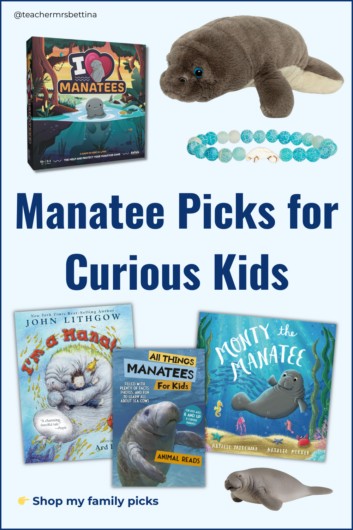
🛒 Build a Manatee Learning Basket
If you want to extend learning gently, a small basket goes a long way. I put together a Manatee Amazon list with:
- Manatee figurines
- A Florida or coastal habitat map
- Marine mammal books
- Aquatic plant images
You don’t need much. Even one good picture book can deepen the experience.
👉 See our Manatee Learning Favorites here
📄 Free Printable: Science Log
If your kids enjoy these activities, the Science Log works perfectly here, for observations, recording ideas, or sketching habitats. It’s the same one we use for STEM posts throughout the year.
Download the free Science Log here

🌊 Manatee Learning Pack – In Development
I’m currently working on a Manatee Learning Unit to go alongside these science activities. It’s designed to help kids understand manatees and the environment they depend on.
Planned pages include:
- Manatee anatomy diagrams
- Buoyancy explanation pages
- Herbivore comparison charts
- Marine habitat maps
- Conservation awareness activities
👉 Notify me when the Manatee Unit is ready
🌊 Final Thoughts on Manatees
Manatees teach us to slow down and listen to our bodies. They help kids see that not every animal survives the same way. Some are built for cold oceans, and some are built for warm coastal waters.
If you try any of these manatee science activities, I’d love to hear about it. Tag @bemandfam on Instagram or Facebook, seeing real learning happen in real homes always means more than you know.
BEM and Fam 🙂