
Vincent van Gogh Art Ideas for Kids
Vincent van Gogh – Art, Emotion, and Color at Home
Even if your kids don’t know his name yet, they’ve likely seen his work. The swirling sky of Starry Night. The bright yellow sunflowers. The thick brushstrokes that feel almost alive.
There’s something about van Gogh that draws people in. His art isn’t quiet or polished. It feels emotional and full of movement. He’s one artist that we have studied at home over the years and it is fun to paint in his bright style.
March 30th marks his birthday, which makes it a natural time to learn a little more about him. But truly, any day is a good day to pull out the paints and explore his work. You don’t need a special reason to study an artist like van Gogh… just a little curiosity and a free afternoon.
Who Was Vincent van Gogh?
Vincent van Gogh was born on March 30, 1853, in the Netherlands. He didn’t become an artist right away. In fact, he tried several careers first, including working in an art gallery, teaching, and serving as a missionary. He didn’t begin painting seriously until his late twenties, which is encouraging for anyone who feels like they’re “starting late.”
In just about ten years, he created more than 2,000 works of art and his early paintings were very different from the bright, swirling images we recognize today. He actually started in realism and was influenced by Dutch artists. Everything changed when he moved to Paris in 1886.
There, he encountered Impressionist artists like Claude Monet and Edgar Degas. Impressionists were painting light instead of objects and they often painted outside. Van Gogh was inspired by their bright colors, but he pushed past Impressionism into something we today call Post Impressionism. While Impressionists painted what they saw in the natural world, Post-Impressionists began painting what they felt about what they saw.
Van Gogh used:
- Bold, expressive color
- Thick paint applied heavily (a technique called impasto)
- Visible, energetic brushstrokes
- Movement and texture
Sadly, van Gogh suffered with depression and sold very few paintings while he was alive. Today, people really appreciate how he painted with emotion… and that is something kids understand!
Exploring Van Gogh as a Family
Van Gogh’s art grows with your children in a different way than some others. Younger kids notice color. Older kids notice emotion. Teens begin to see struggle, symbolism, and artistic evolution.
You don’t need a formal art curriculum to study him. You just need paint, paper, and permission to experiment.
Here’s how to bring van Gogh into your homeschool (or simply into your home life) in a way that fits your family.
| Age Range | What to Explore | How to Experience It |
|---|---|---|
| Young Children (5–8) | Sunflowers or simple landscapes | Talk about bright colors. Use thick brushstrokes. Let them paint freely without correcting. |
| Middle Grades (9–12) | Starry Night or self-portraits | Focus on movement. Try swirling brushstrokes. Experiment with layering paint. |
| Teens (13+) | His life | Discuss emotion in art. Compare early realism to later Post-Impressionism. Create a piece based on a feeling instead of a photo. |
| Parents | Study his artistic transition | Look at early dark works vs. Paris-era brightness. Paint alongside your kids. |
🎨 Weekly Idea: Choose one evening as “Van Gogh Art Night.”
Play quiet music, set out simple supplies, and let everyone reinterpret a small section of one of his paintings.
🎨 Hands-On Van Gogh Art Ideas
Van Gogh’s world invites creativity. Here are a few simple ways to make your own Gogh inspired art…
1. Swirling Sky Painting
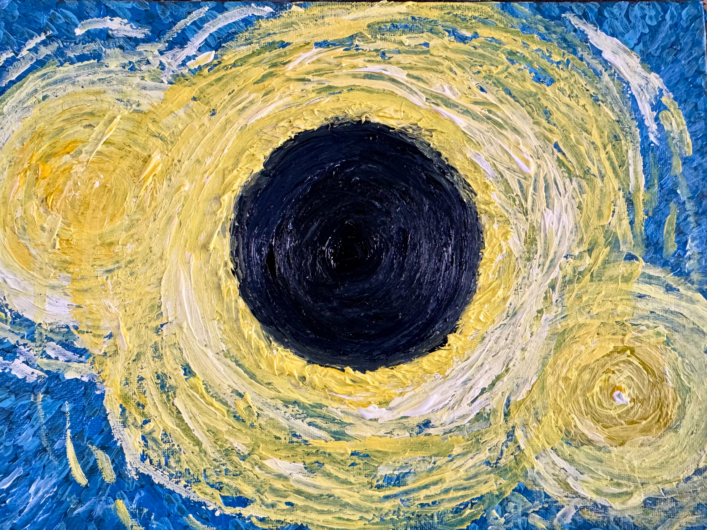
The swirling styles of van Gogh are recognizable to most. This is perfect for any age… those that love to finger paint and those wanting to create a piece of art can really get into this.
The above is a painting I did when the kids and I were doing a study on Vincent van Gogh, I am not a painter so bear with me. My daughter’s is featured below in another experiment. However, mine is supposed to depict the 2024 Solar Eclipse that we were lucky enough to see.
It was a nice day, my husband took the day off of work, and we drove about an hour to be able to see the totality of the eclipse. We were studying Gogh around this time and so I did the painting to show the eclipse (and Venus and Jupiter which were bright during the event too) through van Gogh’s style. I’ve named it, Totality.
Anyway, it might not be great but that isn’t the point. Just have fun and express yourself… art can look like the Statue of David or a banana taped to a wall… only we have to appreciate it.
You’ll need:
- Paint in blues, whites, yellows
- Perhaps use the Impasto Experiment from the next activity
- Thick paper or canvas (recommended)
- Cotton swabs or round brushes
⭐ Look at Starry Night. Notice the movement in the sky.
Instruct:
The goal isn’t to copy van Gogh, it is to be inspired. Point out the motion, which is best done by stepping back.
- Start by having the painters paint the entire canvas or paper a warm color that will match… so a navy or even black.
- Then encourage painters to paint with movement, use quick strokes, paint in circles, to layer lighter colors over darker ones, and to allow brushstrokes to show.
This isn’t about realism… it’s about motion and what they think they see.
Ask…
What would your sky look like if it showed how you feel today?
2. Impasto Texture Experiment
Van Gogh used thick paint, and you can mimic this by creating your own by mixing a little flour into acrylic paint
Basic method:
- Mix flour with water to make a smooth paste (common ratio: 1 part flour to 4 parts water)
- Add the paste gradually to your paint, stirring continuously to avoid lumps
- Test the consistency on a small area before full application.
- Adjust thickness by adding more flour paste or water as needed.
Using a palette knife (or even a butter knife), layer paint thickly and let kids feel the texture. Use this for painting in van Gogh style or anytime.
3. Sunflower Paint and Study
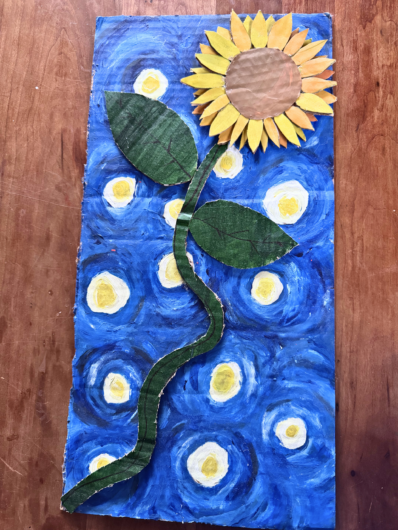
Sunflowers are iconic in art. Many artists have used them as inspiration and Vincent van Gogh’s work is no different. Set a real flower (or photo) on the table and paint it… but encourage bold color.
The leaves don’t have to be perfectly green, and the background doesn’t have to be neutral. Van Gogh often painted ordinary objects in extraordinary ways… let your child do the same.
My daughter painted the above painting, she was drawn by both Starry Night and his use of Sunflowers. This is actually painted cardboard glued together. She did this during our van Gogh study. So, don’t worry about traditional or normal… just have fun!
You’ll Need:
- Heavy paper or canvas
- Paints
- You could use the Impasto method here too
- Paint brushes
Instruct:
- Have painters paint the canvas in one color and build the sunflowers out of the shadows
- Encourage visible brushstrokes
- Suggest adding darker tones for shadows and lighter ones for highlights
🌻 While painting sunflowers, learn about them. Grab this book on sunflowers and maybe even grow your own!
🎨 Build a Simple Van Gogh Basket
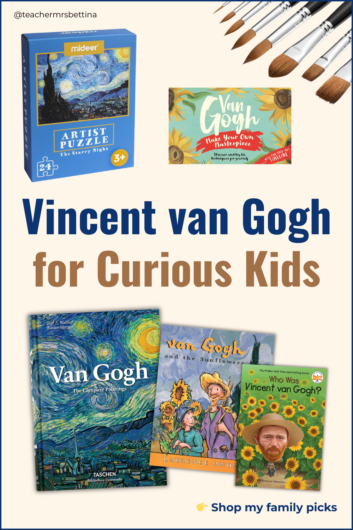
If you want to extend learning about Vincent van Gogh and art in a deeper way, I’ve compiled a list of things that I have used with my children and also in an art class I teach online.
It includes…
- Van Gogh books
- Art supplies
- A simple art history book
- Some fun Gogh items
👉 See my Van Gogh Art Favorites here
🌻 Van Gogh Art Study – Coming Soon
I’m currently working on a Van Gogh Artist Study Pack designed to make this easy to include in your homeschool or at home rhythm. I create units that are great as curriculum but also for weekends or family projects!
It will include:
• Artist biography pages
• Timeline of his life
• Famous works study sheets
• Guided observation questions
• Art project prompts
👉 Notify me when the Van Gogh Study is ready
Final Thoughts
Van Gogh reminds us that art doesn’t have to be perfect to be powerful. It can be emotional, textured, and simple… but still be meaningful. Remember, art is what moves us. If you and your kiddos create art from this study, I urge you to frame it and have a gallery wall.
Whether you mark March 30 as van Gogh’s birthday or simply choose a quiet afternoon or weekend to explore color together, art like this is not only educational and fun, but it creates memories!
If you try any of these Vincent van Gogh art ideas for kids, I’d love to see them. Share your paintings and tag @bemandfam on Instagram or Facebook… real art from real homes always means the most.
BEM and Fam 🙂