
Penguin Science Activities for Kids (Fun Winter STEM Experiments & Facts)
Cold Weather, Cool Birds, and Penguin Science Activities
Penguins have had a soft spot in our home for years, ever since my oldest, who’s now 17, watched Mr. Popper’s Penguins when he was about four. There’s a moment in the movie where one of the penguins lets out a loud fart (not a word I ever expected to type on this blog), and my son laughed so hard. We saw it at the drive-in… warm summer night, windows down, him laughing in the backseat… it made such a sweet little memory.
Something about that moment stuck with him… and honestly, with me too. Ever since then, penguins have been one of his quiet favorites. He still has a few penguin stuffies tucked around his room (the pic above is his), and he always gravitates toward the penguin exhibit anytime we’re at a zoo. He also currently keeps two penguin trackers from Fahlo, one chick and one adult, so he can check in on “his” penguins whenever he feels like it.
It’s funny how a tiny childhood moment can shape what our kids carry with them, what they notice, and what brings them joy. Maybe that’s why penguin science feels so special to me… it’s a little bit of wonder I’ve watched grow up right alongside him.
Maybe that’s why I never mind returning to penguins, year after year. They feel familiar now… part science, part nostalgia, part joy. And while Penguin Awareness Day (January 20th) is a fun reason to explore them, penguin science is wonderful any time of year. Kids naturally love penguins. Penguins are expressive, playful, determined, and full of surprises.
You don’t need a huge setup to study them. Just a few simple activities, a little imagination, and the same curiosity penguins inspire in all of us. Let’s take a gentle, kid-friendly deep dive into penguins… how they live, stay warm, move, eat, and survive in some of the harshest places on Earth.
🐧 So… What Makes Penguins So Interesting?
Penguins break almost every rule kids assume about birds:
- They don’t fly
- They swim better than they walk
- They can drink salt water
- They have more feathers per inch than almost any other animal
Science Facts About Penguins
- Penguins have solid bones, not hollow ones, this helps them dive deep.
- They are birds, but their wings are essentially flippers for underwater “flying.”
- Penguins have a special gland that filters salt, so they can drink ocean water.
- Their black-and-white coloring is camouflage from both above and below.
- Emperor penguins can stay underwater for 20 minutes and dive nearly 1,800 feet.
- Not all penguins live in icy places, some live on beaches, rocky coasts, and even warm islands.
Fun Facts Kids Love
- A group of penguin chicks is called a crèche, basically penguin daycare.
- Penguins slide on their bellies to save energy, it’s called tobogganing.
- Some penguins give their mate a pebble as a sign of affection.
- Penguins have around 100 feathers per square inch, more than any other bird.
- They “talk” with calls as unique as human voices.
⭐ Hands-On Penguin Science Activities
Each activity ties directly to something real penguins do every day — motion, insulation, buoyancy, or survival.
1. Penguin Blubber Glove (How Penguins or Any Arctic or Antarctic Animals Stay Warm)
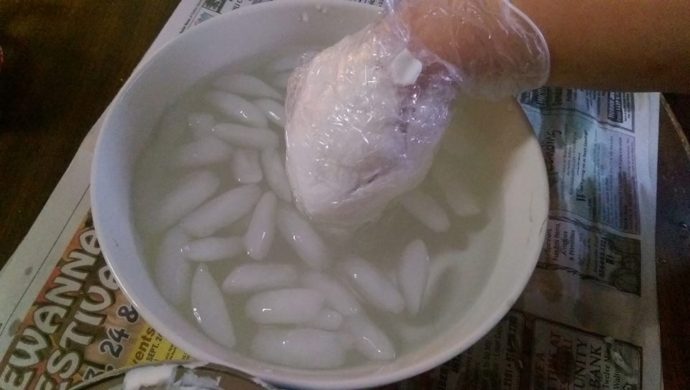
A classic experiment and one my kids still talk about. Kids place one hand in icy water and another inside a “blubber glove” made from shortening between two layers. They instantly feel how fat and feathers insulate penguins in freezing water. Simple, sensory, unforgettable.
👉 If your kids are anything like mine, they’ll love this one. Here’s the Blubber Experiment we did and how to try it at home.
2. Penguin Snow World

A perfect sensory activity for winter. Use the Snow Dough or Snow Slime… links below.
Set out:
- Penguin figurines
- Snow dough or slime
- Ice cube “bergs”
- A small bowl of blue water
- Rocks or shells for “shorelines”
Kids can build habitats, create mini ecosystems, and use story-telling and imaginative play. This works beautifully for toddlers through upper elementary… and if you use the Snow Slime… even longer!
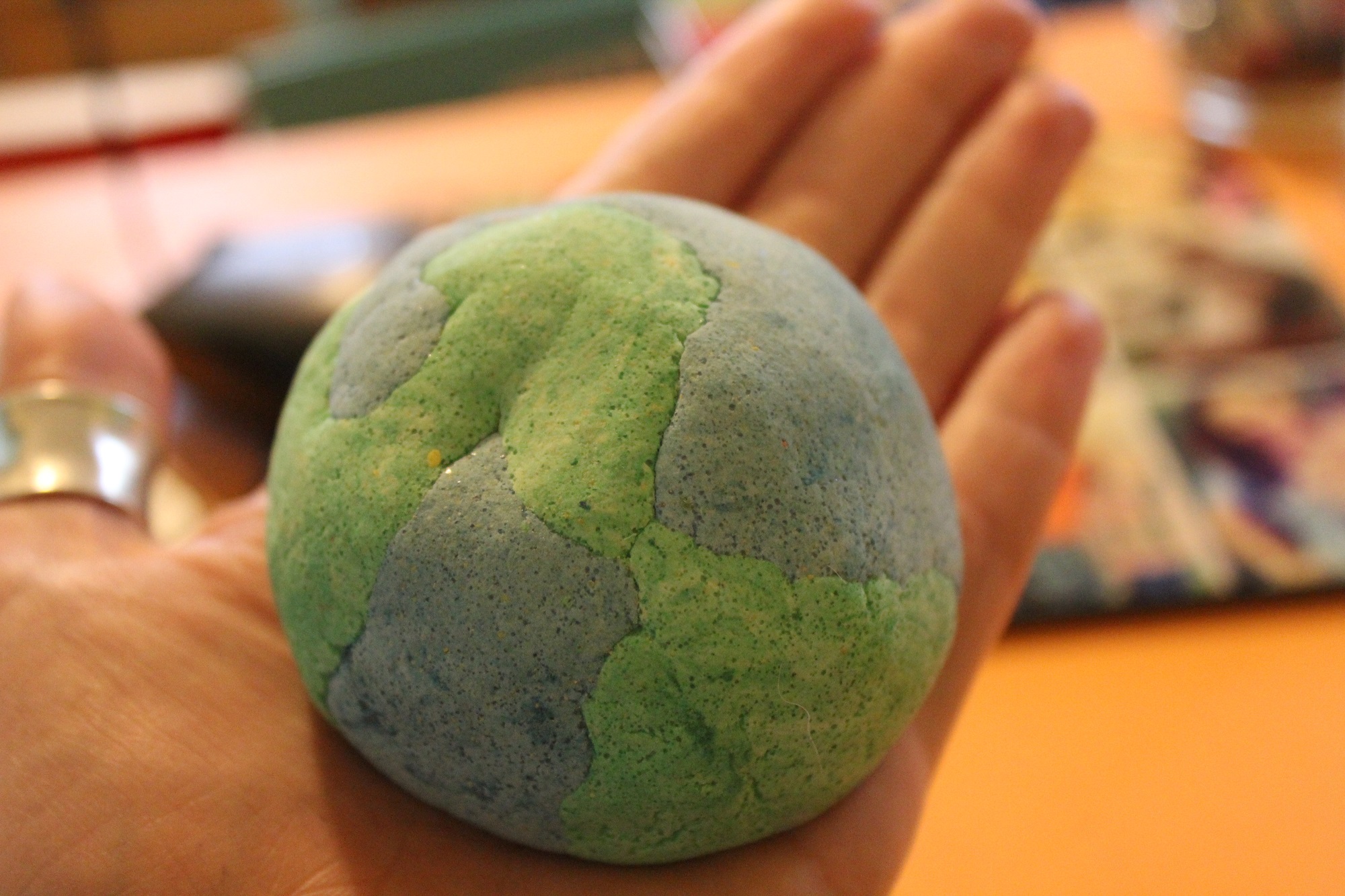
👉 Easy Snow Dough Recipe (shown in pic)
👉 Snow Slime How-To
3. Penguin Balance Challenge
Explore how penguins waddle and balance eggs on their feet.
You’ll Need:
- A small ball, plastic egg, or rolled-up sock
- Stopwatch (optional)
What To Do:
Try to walk slowly while balancing the “egg” on the tops of your feet, no hands! Kids will wobble, laugh, adjust… and suddenly understand why penguins move the way they do.
4. Penguin Geography Map
Print a simple world map and have kids mark where different penguins live. I have a map and a cut and paste activity for these penguins in my Penguin Science Unit below!
- Antarctica — Emperor, Adelie
- South America — Magellanic, Humboldt
- Africa — African penguin
- Australia/New Zealand — Little Blue penguin
- Galápagos — Galápagos penguin
Kids love discovering that not all penguins live in the snow.
🐧 More Penguin Ideas
⭐ Penguin Learning Pack
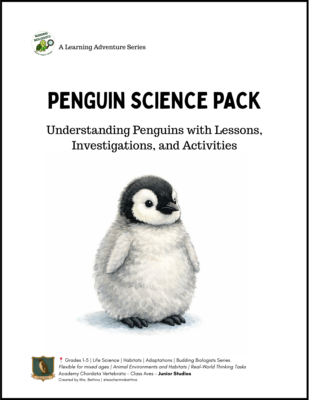
If your kids enjoy digging deeper, my Penguin Science Pack expands on these ideas with:
- Penguin information for kids
- Life cycle pages
- Penguin mini-book
- Habitat + geography map
- Observation pages
- Penguin fact cards
- Penguins in Peril – a Problem Based Learning (PBL) Zoo mission
- STEM extensions
This is designed to be used at home, in co-ops, or even in the classroom. And while it is a stand-alone unit, there is the opportunity to turn it into a deeper connected learning experience through the Academy Chordata Vertebrata… which is my part of my Teacher Mrs. Bettina brand.
👉 Explore the Budding Biologist Penguin Unit here
⭐ Build a Penguin Learning Basket
If you want to dive deeper, I put together a small Penguin Amazon list with:
- Penguin figurines
- Picture books
- Life cycle cards
- Ice cube trays for sensory play
- A magnifying glass
- Fun extras!
👉 Penguin Learning Basket Amazon List

📄 Free Printable: My Science Log
If your kids enjoy hands-on science, I put together a Science Log that works for some of these penguin science activities and for activities in my Ben Franklin post, Isaac Newton post, and all our other STEM posts throughout the year.
👉 Download the free Science Log here
🐧 Penguin Wrap-up
If you want to build out a full penguin day (or week) at home, here are a few extras our family has loved:
• Our Favorite Penguin Toys
A simple, durable penguin figurine or play set goes a long way for sensory play and storytelling.
👉 See our favorite penguin pick here.
• Snow Dough & Snow Slime
Both are kid-favorites and pair perfectly with penguin sensory worlds.
👉 Easy Snow Dough Recipe
👉 Snow Slime How-To
• Penguin Learning Basket (Amazon List)
Books, figurines, STEM tools, and cozy extras to make winter learning simple.
👉 Browse the Penguin Learning Basket
• Penguin Science Unit
Great for those that really want to learn more and have a full penguin experience.
👉 Get your Penguin Unit here
• Quick Penguin Watch
If you want to wind down after the activities, try a penguin documentary clip or a behind-the-scenes zoo video. I recommend March of the Penguins documentary or a penguin cam, like the one at the Georgia Aquarium (though others have them too).
❤️ Final Thoughts on Penguins
Penguins remind us that resilience doesn’t always look like toughness, sometimes it looks like teamwork, warmth, curiosity, and the ability to keep going across obstacles, even when those are cold and windy.
Celebrating Penguin Awareness Day (or any day) with simple activities and playful science brings that spirit right into your home.
If you try any of these penguin science activities, I’d love to see them! Share in the comments or tag me on Instagram and Facebook @bemandfam… it absolutely makes my day.
BEM and Fam 🙂
👉 Save This for Later