Teaching Honesty to Kids
Teaching Honesty and What Works at Home
Honesty sounds simple… until you’re standing in the kitchen holding the evidence and your kid is still saying, “I didn’t do it.” Suddenly it’s not even about the thing anymore, it’s about the lie.
That is the part that always catches me off guard, maybe with my upbringing and being lied to and let down so much… I just can’t stand lying. But honesty doesn’t just… happen. It is something we learn and teach, but it is also something we choose.
Why Teaching Honesty Matters (Even When It’s Uncomfortable)
I think part of why is so important for me is because honesty isn’t really about rules, it’s about trust.
When a child tells the truth, even when they know they might get in trouble, it builds something. You start to feel like you can rely on what they say. They start to feel safe being known, even when they mess up, and when they don’t… it creates distance.
That’s why this matters so much, not because we expect kids to be perfect, but because honesty is what holds relationships together over time. It’s also something they carry with them outside of our homes and into their adult lives.
If they learn early that the truth is something you face, not something you avoid, it shapes the way they move through the world.
The hard part is… it doesn’t come from one big talk. It comes from all the small moments when we decide how to respond.
What Teaching Honesty Actually Looks Like at Home
This is the part I think gets misunderstood because it’s easy to picture “teaching honesty” as a lesson or a sit-down conversation, but most of the time, it looks a lot more ordinary than that.
Here are a few ways teaching honesty happens at home.
1. Catching the moment without blowing it up
There are times I’ve wanted to react immediately… and sometimes I have. I’ve noticed that when everything escalates quickly, the focus shifts from the truth to the reaction.
I’ve always tried to stay as calm as I could, especially when my kids were younger, because I didn’t want them to connect telling the truth with me overreacting. If telling the truth feels like walking into something intense, they’re going to hesitate next time.
That doesn’t mean ignoring it. I’ve never ignored a lie. I just try not to turn it into something bigger than it needs to be in that moment.
Because what I really want is the truth… not a shutdown, not defensiveness, not a battle, and sometimes keeping things steady is what makes that possible.
2. Helping them understand what trust actually means
This is something I don’t think we talk about enough with kids. We say, “Don’t lie,” but we don’t always explain why it matters beyond getting in trouble.
At some point, I started explaining it more directly. Not in a lecture… just in real conversation. I explained that trust is what makes relationships feel safe. That when someone lies, even about small things, it starts to create doubt, and when people aren’t sure they can believe you, they start to pull back a little.
I’ve explained it in ways they can understand:
If a teacher keeps catching a student in lies, they’re going to double-check everything.
If a grandparent isn’t sure what’s true, they’re going to hesitate before saying yes to things.
If I’m not sure what’s true, it makes it harder for me to give freedom or trust decisions.
Not as a threat, but just as reality… because everyone wants to be trusted. Everyone wants people to feel comfortable believing them.
Honesty is what builds that over time and explaining that clearly and regularly, is important.
3. Being clear about truth, consequences, and second chances
This is probably where I’ve landed the most over time. I’ve told my kids more than once…
If something happened, we’ll deal with it, but I would rather hear the truth now than have it turn into something bigger later. Because there’s a difference between making a mistake (even deliberately) and continuing to lie about it.
The mistake might have a consequence, but continuing to lie creates something else, it puts a wedge in trust. That part matters more in the long run. I also try to leave space for them to come back from the lie and to tell the truth, even if it takes a minute.
I don’t want honesty to feel like an all-or-nothing moment. I want it to feel like something they can choose… even after they’ve messed up.
4. Showing them what honesty looks like in real life
This is something I became very aware of as they got older. If I expect them to be honest, then I have to be someone they can trust too.
That means following through when I say I will. Admitting when I’m wrong. Not making excuses or covering things up.
There were times I made very intentional choices around this, because I didn’t want there to be confusion later about what honesty looks like.
I wanted them to know… I’m not going to lie to you. Even when it would be easier. Even when it would smooth something over. Because if they believe that, then when I say something, especially something they don’t want to hear, they know it’s coming from a real place, and that matters more than always being liked in the moment.
5. Don’t assume they “know better” as they get older
This is probably the biggest mistake I see, and honestly, it’s an easy one to make. At some point, we feel like…
- “They’ve been taught this.”
- “They know right from wrong.”
- “We’ve already had this conversation.”
But knowing something and choosing something are not the same thing, and if anything, honesty gets harder as kids get older… not easier.
When they’re little, the stakes are small. It’s things like toys, snacks, little moments. However, as they grow, everything gets bigger. More freedom, more responsibility, and more consequences. Which can equate to more reasons to lie.
When a teenager tells you they’re going one place and they end up somewhere else, that’s not just a small thing. That directly affects trust. Now it’s not just about honesty in the moment… it’s about safety, responsibility, and whether you can rely on what they say.
And that impacts everything:
- Whether they can stay out later
- Whether they can go somewhere without you
- Whether you feel comfortable saying yes next time
Trust isn’t just a value at that point, it’s the foundation for their independence. If that trust starts to crack, it changes the way you parent. It has to. That’s why this isn’t a conversation we have once and move on from. It’s something we come back to.
Because even kids who know better still make choices in the moment. Even kids raised in strong homes and who’ve been taught clearly.
I’ve noticed something else too. The more open the conversation is, the more you tend to actually know what’s going on. Kids are a lot more likely to be honest when they know they can talk without everything immediately turning into a shutdown or a lecture. That doesn’t mean there aren’t boundaries or consequences. It just means honesty stays part of the relationship… not something that only comes up when something goes wrong.
In the long run, honesty isn’t just about avoiding trouble. It’s about helping them become someone who tells the truth, even when it would be easier not to.
Simple Ways to Practice Honesty, Without Making It a Big Deal
If you want to be a little more intentional without turning it into a heavy conversation, here are a few easy ways to work honesty into everyday life:
- Ask “what would you do?” questions
- Talk through real-life scenarios casually
- Share your own small mistakes
- Let them see honesty modeled in normal conversation
Make honesty and trust a family value early on, and work on making it stick.
A Simple Honesty Activity That Makes It Click
This is something I did with my kids when they were small. All you need is a ball of yarn.
Sit down together, around the table, on the floor, wherever, and start telling a simple story. It can be completely made up. As you tell it, start wrapping the yarn around the kids, a chair, passing it across the table, looping it around things nearby. Then add in a small “lie” to the story.
Keep going. Each time, keep wrapping or crossing the yarn somewhere new, around a chair leg, across someone’s arm, and before long, you end up with this tangled web stretched across the room.
When you are done, say something like:
“This is kind of what happens when we don’t tell the truth. One small thing turns into something bigger, and then it gets harder to untangle.”
If you want, you can take a minute and slowly start unwinding it or you can leave it for a bit and let them sit with it. Either way, it gives them something they can see, not just something they’re told. It’s a small thing, but it’s the kind of visual that helps bring the idea of honesty out of “just words” and into something they can actually understand.
A Few Things That Help These Conversations Go Easier
⭐ Honesty Freebie Download
If you want a simple way to start these conversations without turning it into a big lesson, I put together a small printable you can use at home. It’s just a few real-life prompts and questions that help kids think through honesty in a way that actually makes sense to them.
Nothing complicated, just something to give you a starting point when you need it.
⭐ Honesty and Character Unit
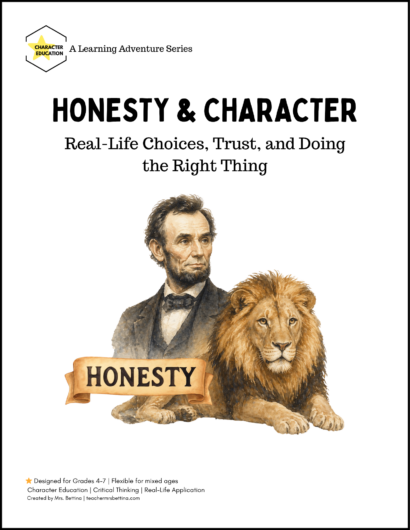
Once I began teaching online, I created an honesty class. To assist my students, I created a lesson that helped kids understand honesty and trust. I used what I learned with my kids and built something that parents could use at home or teachers could use in their classrooms.
Over the years, the lesson became a unit, and part of a bigger Character Education system.
This Honesty and Character Unit is flexible, cross-curricular, and helps kids actually think through what honesty looks like in real life.
Inside you’ll find:
- real-life situations kids actually recognize
- simple prompts that open up conversation instead of shutting it down
- a reflection spaces that give them space to think, not just respond
- crafts and games
- suggested guides and deeper ideas
It’s something you can use at home, pull out when you need it, or even use more intentionally if you want to.
👉 Grab the Honesty and Character Unit here
⭐ Honesty Literature and Tools
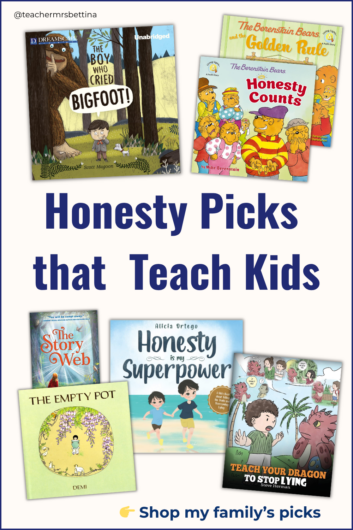
Sometimes having a few tools nearby helps take the pressure off. We had several books when the kids were younger about honesty. A favorite was The Empty Pot, but we had several. This made the topic more natural as the kids were seeing our conversations enforced in the literature.
Having a journal might help for those frustrating moments when kids and teens want to get stuff of their chests.
I created an Amazon Honesty list with tools that we had, mainly books, that helped encourage honesty. You don’t need a lot, just one or two can make these conversations feel more natural over time.
Final Thoughts
At the end of the day, honesty isn’t about raising kids who never mess up. It’s about raising kids who are willing to tell the truth when they do. That doesn’t happen because we told them once not to lie. It happens because we keep showing them, over time, that honesty matters, that trust matters, and that telling the truth is always the better choice… even when it’s uncomfortable.
If honesty has been an issue for your home or if any of these ideas help in teaching honesty to kids… I’d love to hear it, and I am sure there are other parents that would too. Comment below or tag @bemandfam on Instagram or Facebook with pics of your favorite honesty tools!
BEM and Fam 🙂
Save This for Later

PS. This post has some affiliate links, read more about those here.